‹ All learning
AI 101
A visual guide to understanding AI for knowledge workers.
Transcript
Copy transcript
0:00
presentation in case you want to use it yourself.
0:05
And yeah, so we kind of designed this presentation with, you know, a working
0:10
professional audience in mind, you know, it's not meant to be a hype talk or two in
0:15
the weeds, but meant to give you a bit of context and guiding principles when
0:20
thinking about this new tool.
0:22
So I always like to underline the, how big AI is like in terms of human history.
0:30
So, you know, please bear with me for a bit of a history here.
0:37
So in terms of tools, like, you know, tools that human use, probably one of the
0:42
most impactful has been the human, the hand axe, you know, it was used by the
0:48
early hominid species and, you know, anthropologists say, like, the use of
0:53
this tool and tools like it are what spurred our evolution into Homo sapiens.
0:59
So it's important to think about, you know, because it helped us, it helped every
1:03
given human do more.
1:04
And that's kind of a pattern we'll see with tools like this.
1:09
So that was like, you know, about 2 million years ago, but fast forward to
1:14
1440, and we, I want to highlight the printing press, because before this time,
1:21
you know, most of the population was illiterate, you know, we couldn't read.
1:26
But because books were so expensive to create, you know, a tribe would spend
1:32
weeks, months copying over from a master book, writing, writing new books over and
1:40
over again.
1:41
And this just meant that literacy and books were for the elites.
1:45
But with the printing press, it became much cheaper to produce, you know, books
1:49
and satisfy the human desire to learn more about the world, you know, what's
1:52
going on in different parts of the world.
1:55
So literacy became more pronounced in the population.
1:59
And with that, you saw major, like, societal movements, you know, including
2:03
scientific revolution.
2:04
Then we fast forward to the internet, you know, late 20th century.
2:09
What the internet did was, you know, a lot, you know, what made the world like
2:14
much smaller.
2:17
Just like the printing press, like people are able to produce content and ideas
2:20
are able to come out there, including things like, you know, e-commerce and
2:24
social media.
2:26
So it enabled information sharing at a much greater scale.
2:30
Now, let's start actually getting into AI.
2:33
So one of the most important, like, you know, bits of history for AI was when
2:37
this paper called Attention is All You Need was published by a couple of Google
2:41
researchers.
2:43
And, you know, what it may be some of you remember, like using Google Translate
2:48
before 2017 and then after.
2:52
But if you do, you'll notice like it got got much better.
2:56
And it was because of this fundamental technology called the Transformer, which
3:00
was a type of neural network that paid instead of just translating words, it
3:07
paid attention to the context words existed.
3:09
We'll talk more about this.
3:11
So then five years later, ChazGPT launched.
3:16
And now we're continuing to talk about history because it became the fastest
3:20
growing consumer app in history.
3:22
It became the fastest growing consumer app in history, eclipsing TikTok and
3:26
Instagram because it reached like 100 million users in just two months.
3:30
And this is when this technology, this Transformer neural network technology
3:34
moved from a research lab to the public consciousness, to everybody's phones.
3:40
And then just last year, another history breaking technology came out called
3:46
PlotCode.
3:47
And it involved AI from just answering questions to actually doing work.
3:54
So, you know, this type of role, software engineers who build software.
3:58
It was able to do exactly the kind of work software engineers do to the point
4:04
where, you know, people are questioning whether the job of a software engineer
4:08
will exist in the future.
4:11
So, yeah, we especially moved to the doing error last year from just the chatting
4:16
error with these tools.
4:19
And, you know, we're talking about numbers and science, but I want to kind of
4:24
highlight a new story that just kind of demonstrates what people can do with
4:31
this tool now.
4:33
So there was this guy, Australian guy, software entrepreneur called Paul
4:36
Cunningham.
4:37
And, you know, his dog got cancer.
4:40
And so he was giving it a certain amount of time to live.
4:43
And, you know, he wanted to do something about it.
4:47
So he used a collection of these AI chatbots from Chatbot, Chazipute, Gemini,
4:51
Grok.
4:53
And over the process of like, you know, a couple of months, he created his own
4:57
like mRNA vaccine.
4:59
You know, he got his dog's genome sequence.
5:01
He did all the research.
5:02
He did a lot of learning.
5:04
And this is all by someone who has no background in medicine.
5:07
So he learned everything he needed to to create this mRNA vaccine.
5:11
And, you know, deployed it for his dog.
5:14
And the dog's cancer started to recede.
5:18
So, you know, this is exactly the kind of like, you know, use case that people
5:22
are able to do now, given that they have enough agency.
5:26
So I want to highlight this quote by Paul.
5:29
He said, The chatbots empowered me as an individual to act with the power of a
5:33
research institute.
5:34
Planning, education, troubleshooting, compliance, and yes, real scientific
5:38
design, working and converting genomic data into a vaccine prescription.
5:43
But they worked alongside humans at every step.
5:46
The combination is what made it possible.
5:49
So, yeah, you know, I love that story.
5:50
So I like to highlight it.
5:53
So now let's get into how this AI, you know, actually works.
5:57
So you can get rid of AI.
5:59
So, you know, as you will know, the fundamental like feature of this AI is
6:05
that it generates text.
6:06
It generates human-like text.
6:09
But, you know, to understand the text, it generates it and it has to segment the
6:15
text in a certain way.
6:17
So it generates what's called tokens from text.
6:21
So with this English sentence, it's tokenized in a fairly understandable way.
6:27
One token for every word.
6:29
All right.
6:31
So the way these models are trained, it's trained on a bunch of text, mostly
6:37
the Internet, you know.
6:39
They take a lot of, you know, textbooks that exist on the Internet to help the
6:45
transformer model understand the context that each word is used, you know.
6:52
Like take, for example, a word like agency, you know, it shows up in many
6:57
different, in a few different contexts.
6:59
And we can probably, you know, group it in two different contexts, which I'll
7:02
get into.
7:04
All right.
7:06
So what the transformer is doing is predicting the next token, or to
7:11
simplify, we can say predicting the next word.
7:14
So for the example of agency means, you know, when it's predicting the next
7:19
word, it might predict like government body that, you know, agency means a
7:23
government body.
7:24
But, you know, if you change the sentence a little bit to have human in front
7:27
of it, like human agency means, then it's more likely to predict the next words
7:31
will be personal autonomy.
7:32
So in that, it's able to understand a different context that words are used.
7:36
And that's part of what makes it generate human-like text.
7:40
But note that this is still a prediction at the end of the day, you know.
7:45
The way we generate text, we reason a bit more than this.
7:48
You know, this is just predicting what will come next based on what it's seen
7:52
in this training data.
7:55
And yeah, as part of that, you know, these models don't understand like facts.
8:01
They're just predicting the next token based on patterns in the training data.
8:08
And so, you know, you might prompt an early version of this model, who founded
8:12
the Red Cross?
8:13
And it might give you the right answer, you know, that Henry Durant founded the
8:16
Red Cross in 1863 because it's cleaner in the training data, not because it's
8:20
reasoned about it.
8:21
So that's very important to understand.
8:24
And here's an example of where that can go right.
8:27
You know, you asked the question about the 2019 Nairobi Declaration.
8:31
And there was a Nairobi Declaration, but it wasn't about climate finance.
8:35
But it confidently outputs text thinking like there was a Nairobi Declaration
8:40
about climate finance and making up percentages and even dates and things.
8:47
This is a hallucination.
8:48
This is what we call a hallucination.
8:50
The model is just confidently outputting patterns based on what it's seen in the
8:54
It's not reasoned about it like, hey, is this true or not?
8:58
So, yes, you know, hallucination is not an unsolved problem.
9:04
So, yeah, I want to cite the study that was actually just published last year
9:08
where they asked medical queries of, you know, different open air models with
9:16
and without source documents.
9:17
And by source documents, it just means like asking the model to refer to a
9:22
bank of documents to inform its answer versus just answering directly.
9:28
So without, you know, this knowledge base, you know, the hallucination rates are
9:33
very high, you know, unacceptable in any domain.
9:37
But by simply just asking the model to refer to a set of authoritative documents,
9:42
they were able to bring the hallucination rate down to zero.
9:46
And so this pattern of asking the model to refer to a knowledge base or, you know,
9:53
modernly refer to tools like web search and other things like that has practically
9:58
eliminated this problem of hallucination.
10:00
Obviously, we still need to write evals, which I'll get into.
10:04
But there is a way to mitigate this hallucination problem to make it near zero.
10:09
Anyhow, you know, an important thing to highlight is that the way these models
10:14
were built, they were built to support Western languages the best because that's
10:19
that's what builds up the Internet.
10:22
And that's what the researchers and the team behind these models speak the best,
10:26
you know, mainly English.
10:29
So, you know, the example sentence I gave earlier, you know, we enhance human agency.
10:35
Here's the same sentence in Swahili.
10:38
And, you know, it even has the same number of words happen to have the same number of words.
10:43
Let's see how this gets tokenized compared to English.
10:47
As you can see, English gets tokenized in a reasonable way, you know, by by word
10:52
and for complex words, it might get tokenized by suffix and prefix and things like that.
10:57
But Swahili is tokenized in an incoherent way.
11:01
You know, if you know Swahili, like this is not these tokens are not logically grouped,
11:06
you know, it's not by word, it's not by parts of word or anything like that.
11:10
And, you know, like I said, this is because the models are used to dealing with English
11:14
the best. But this has important implications for performance and pricing.
11:22
So, yeah, yeah, here just for that same sentence translated into different languages,
11:28
we're counting how many tokens get produced.
11:31
So, you know, English is four, but and French and Spanish, not that much more.
11:37
But as we get into non-Western languages, you know, throughout Asia and Africa,
11:43
you notice that they have more tokens that are produced for the equivalent phase.
11:48
And because these models are priced by tokens, they charge you based on how many tokens
11:55
in the input and how many tokens in the output.
11:58
It means that, you know, to support these AI, to use these AI models for non-English languages
12:03
is going to cost you a lot more, basically, you know, especially by the multipliers you see here.
12:08
So, yeah, you know, just a simple example, like if you're building a maternity ward health chatbot,
12:13
as we see in the among our grantees who are piloting AI.
12:17
For a given set of queries, thousand queries, you know, it might cost like 42 cents to do them in English,
12:24
but it will cost over double the price to generate those responses in Swahili.
12:32
And, you know, it's not, you don't get the same quality with this
12:35
because these models have an important phenomenon called a context rut.
12:40
So, they have, let's say, like a limited amount of space, like working memory.
12:44
You can think of it as working memory.
12:46
And the more that is filled up, the worse the performance is.
12:52
So, if you're supporting a non-English language and, you know, just because it's not in English,
12:57
it just means more of that working memory is taken up.
13:00
That also means the quality will be worse.
13:04
So, that's important to think about.
13:06
Yeah.
13:07
What was the phrase you just used to describe that phenomenon?
13:10
Context rut.
13:11
R-O-T.
13:13
That's super helpful.
13:14
I've been noticing that in flawed code that, like, after 150,000, I've been calling it dumb mode, but this is...
13:22
Yeah, yeah.
13:24
And then, you know, just as a quick aside, you know, this is very important, even for English queries,
13:29
because maybe you notice, like, you've heard the news story last year of, you know, the child that committed suicide
13:37
because he was talking to a child LGBT, and at some point, child LGBT started, like, encouraging him to commit suicide.
13:45
It was because the conversation ran on for months.
13:49
It was one conversation, and it ran on for months.
13:52
At a certain point, the safety guardrails that OpenAI has to, like, prevent this kind of thing eroded completely.
13:59
So, performance, like, you know, more context is taken up.
14:03
Performance can degrade pretty rapidly.
14:06
But, you know, there's some solutions for that now, especially.
14:10
Hey, sorry.
14:11
I have a question, too, if you don't mind.
14:13
You were talking through kind of...
14:15
The preface to this was about kind of how the early models of LLMs, early as in, like, two years ago, were being kind of constructed.
14:23
I'm curious whether, and maybe you're going to get to this, but whether what you're talking about now is sort of rooted in the early model design
14:30
of kind of the tokenization in different languages and everything,
14:33
or whether, like, that's also as relevant today with some of the more advanced models.
14:39
Yeah, it's relevant today.
14:40
So, with the more advanced models and, you know, ways of working, they're kind of built on top of this early model.
14:47
So, we'll get into that.
14:51
Okay.
14:52
So, as I've described these models, they're predicting the next token.
14:56
They're just guessing what the text comes next.
14:59
But there's some work that these model labs do to make them like an assistant, you know, to make them more safe and easy and friendly to use.
15:09
So, I want to quickly touch on these.
15:12
So, yeah, you know, like a freshly portrayed model is a prediction engine.
15:19
And so, the answers to a lot of, like, realistic queries will not be as useful, you know.
15:26
If somebody asks, like, how might you treat a burn?
15:28
Just a pre-trained model might just say, hey, burns are a common injury that can result from heat.
15:34
The word burn, you know, will get us to the etymology.
15:36
It will not be answering the person's question because you can see how this is, like, based on these patterns of where it's seeing the word burn.
15:45
It's just kind of predicting, like, what the definition is and not being actually useful.
15:50
So, there's a technique called instruction tuning that simply you just give the model a bunch of question and answer pairs to get it used to answering questions.
16:02
Because as it was trained before, it was used to just predicting what the next word would be.
16:09
But that's not useful, you know.
16:10
So, to make it useful to answering humans' questions, you just feed it a bunch of QA pairs.
16:15
And this is called instruction tuning.
16:18
But, you know, this version of the model, the instruction tuning model, will answer any question.
16:25
If you ask it to make a bomb, it will answer, you know, it will tell you.
16:28
And so, it's seen as unsafe, you know.
16:30
So, there's a bit more work to do to make it useful and safe.
16:35
So, the final layer of, you know, post-training that's done with these models is something called reinforcement learning with human feedback.
16:42
And what it means is that you're giving the model feedback.
16:46
You're getting the model to generate, like, a few different responses.
16:50
And then you're reading the model's responses to tell it, like, hey, this was better than this.
16:55
And so, it is, in a diffusive way, learning what a good answer should look like.
17:02
And, you know, the research model uses this technique to prevent it from giving, you know, medical advice or financial advice or, you know, answering unsafe queries, like how to make a bomb or, you know, how to commit suicide or something like that.
17:16
And, you know, this makes it generate the responses that you might be used to today.
17:22
You know, responses that maybe go over a few options but will not go too far, you know, will not answer all queries.
17:30
It seems to use some kind of judgment.
17:32
So, that's important to touch on.
17:34
But, you know, the safety training is actually mostly done in English, you know.
17:41
So, you know, if there's an unsafe query, like, you know, how to make a bomb, it might refuse in English.
17:48
But if you ask it in a lower resource language, you know, Amharic, Swahili, it might actually answer.
17:55
Because the reinforcement learning with the human feedback stuff is kind of an expensive process that relies on data annotators and people with expertise on certain topics.
18:03
So, it's mostly done in English.
18:05
So, this is an important thing to caveat.
18:07
And also, you know, the people that are doing this reinforcement learning with human feedback are primarily, you know, from the global south.
18:15
There was an industry of using data annotators by, like, companies like Facebook for, you know, labeling offensive content and things like that.
18:25
And those same industries have been reused to train these models.
18:28
And, yeah, you know, there's an important, like, you know, labor dynamic here.
18:36
Okay.
18:38
So, I want to get a bit into, like, one, there's how you can use AI in your daily work.
18:46
But, you know, as funders, we're getting these proposals where people are proposing, you know, different AI interventions and how they're going to use it in their organization, how they're going to use it to impact their beneficiaries.
18:57
So, I want to talk a bit about, like, you know, in addition to deploying AI, like, how do we evaluate it?
19:05
How do we think about evaluating AI?
19:09
So, we launched an accelerator last year, you know, the AI for Global Development Accelerator with OpenAI and Center for Global Development.
19:18
And we had eight organizations pilot AI interventions, and we were able to work with them, you know, as part of deployment and time and see where exactly to struggle.
19:26
And evaluation, like, understanding, like, what the AI product they built, if it's actually working, was the top item that folks struggle with, you know.
19:35
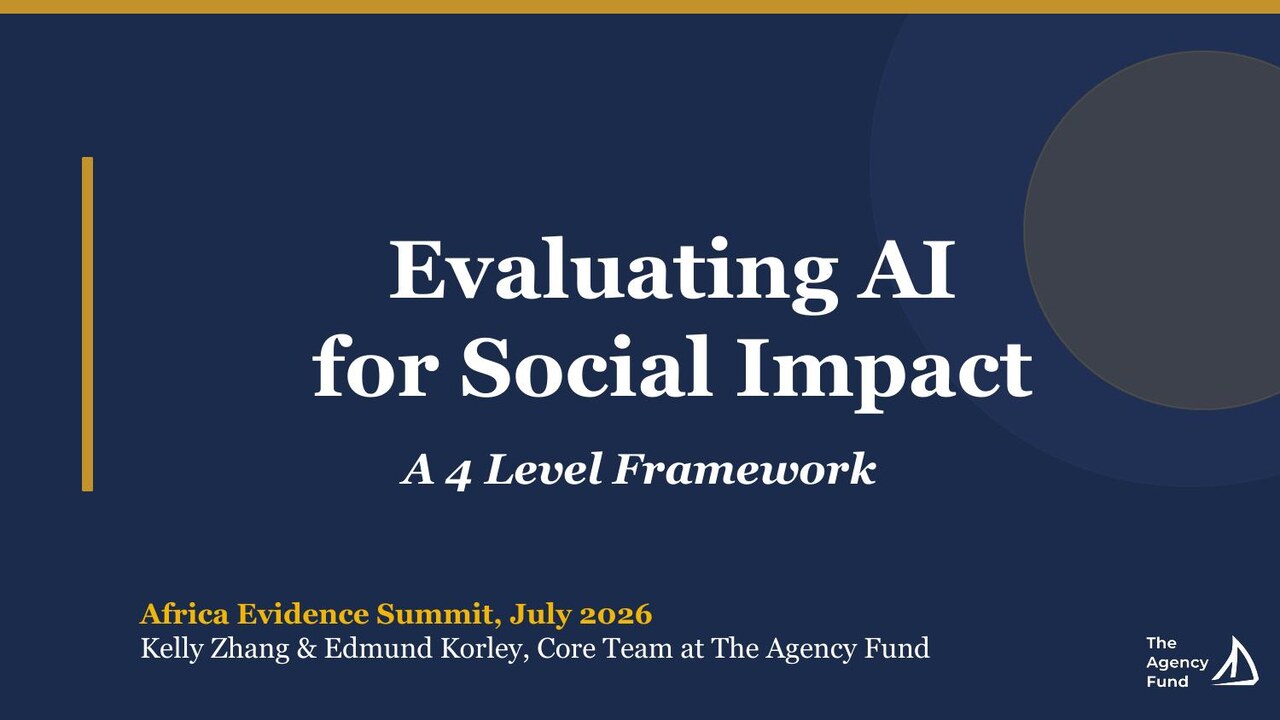
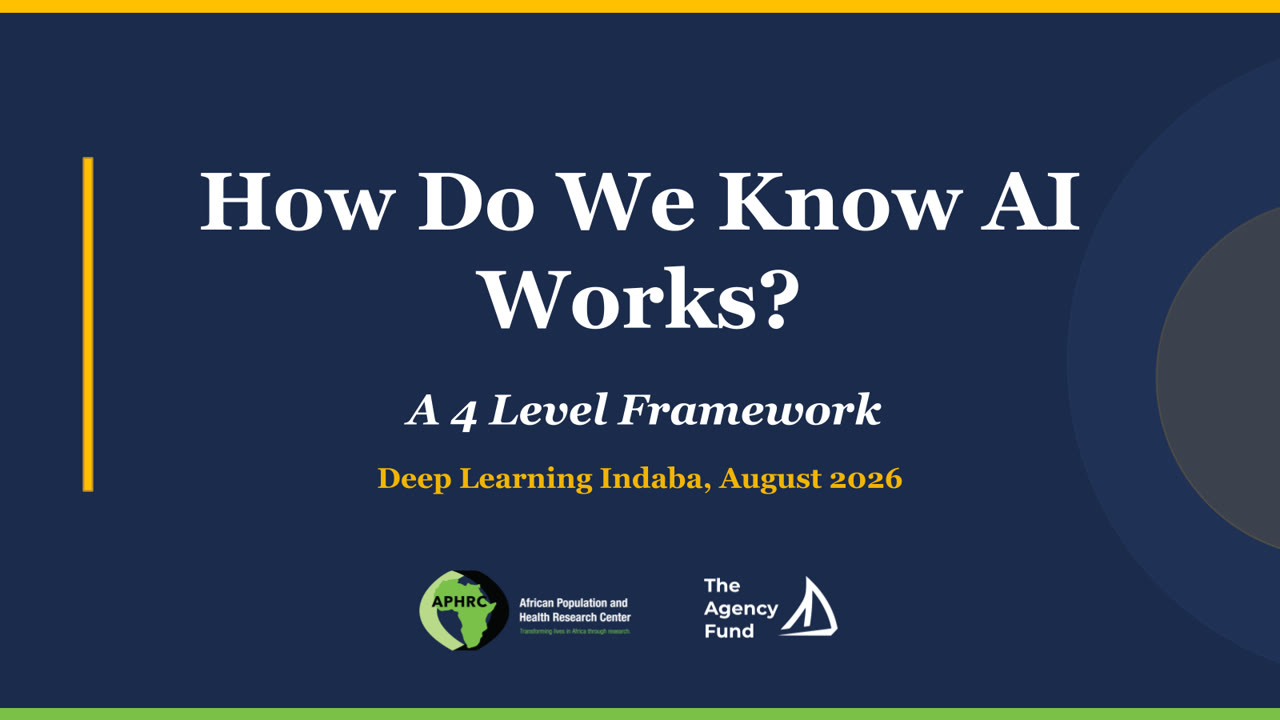
So, we developed this four-level framework to think about evaluating AI.
19:40
And we'll mostly just get into L1, but I wanted to touch on all of them.
19:44
So, L1 is, like, before deploying the users, does the AI behave the way you want?
19:49
Can you compute some metrics of how it's behaving?
19:52
And then L2 is where we measure traditional product metrics, like, are people using it?
19:58
You know, monthly active users, daily active users, things like that.
20:02
And then beyond them using it, L3, we look at, is this positively influencing user behavior?
20:09
You know, are they learning more?
20:10
Are they, you know, uptaking more health-seeking behaviors?
20:14
Things like that.
20:15
And, you know, the fourth layer, we're looking at if this improves development outcomes, you know.
20:21
And part of this is because, you know, in RCT, the currency for, like, impact takes a long time and is very expensive to do.
20:29
So, with this faith evaluation framework, can we think about building successive bits of confidence before, you know, taking on the big bad RCT?
20:38
And, yeah, you know, just to get into what it actually looks like to do model evaluation,
20:43
you're essentially defining specific dimensions you want to evaluate your chatbot on.
20:48
You know, it could be factual accuracy because we know, like, you know, hallucination is a big problem.
20:55
Or it can be, you know, checking for safety, making sure it doesn't, you know,
20:59
recommend specific drugs or prescriptions or things like that to use where a medical professional should be used.
21:07
And given that a lot of this level of model evaluation is related to safety.
21:16
Sorry, let me drink.
21:20
Yeah, this level, most of this level of model evaluation is related to safety because of the liability, you know.
21:30
Like, if somebody takes the wrong medication because of, you know, what the AI chatbot recommended
21:38
or goes and buys certain stuff because of what the AI chatbot recommended,
21:42
generally, you want to avoid, like, having the AI chatbot do that just because of the legal risk.
21:49
And, yeah, here are some examples of, you know, these kind of, like, level two and level three metrics.
21:55
If you have some kind of onboarding floor, specific tasks users are supposed to do with the help of the chatbot,
21:59
you should measure that. You should treat the chat experience like a funnel and measure where users drop off and things like that.
22:11
Okay, so let's skip these slides, but just get into that.
22:15
Hey, we deal with evaluation thoroughly in this eval playbook that we created with the Center for Global Development and IDinsight.
22:26
And another thing that came up a lot with a lot of the awardees building with AI is, like, how to deal with data.
22:34
Given that some countries are, you know, want data to be processed in-country,
22:40
it's important to think about, like, when users are talking to these AI systems, what's happening with the data?
22:46
And it was the case that up to 2024, yeah, the servers that are processing these AI responses are mostly in the U.S. or in Europe.
23:01
So for Africa or India and organizations building with these who had requirements to be in-country,
23:06
their only option was, you know, using open models, open source models that they could host themselves.
23:13
Jacaranda Health, one of our grantees, they went down the path of fine-tuning LAMA
23:18
because, yeah, the off-the-shelf models that you have servers in Kenya that they could use are even on the African continent.
23:26
That's changing, you know, now there are providers like OpenAI have in-country affordances in India.
23:35
But, yeah, you know, it's yet to be the case in Africa yet.
23:39
And given that the beneficiaries, when they're talking to these chatbots, and it's a personalized experience,
23:44
they're likely to reveal a lot of, like, PII, personable identifiable information, very sensitive information,
23:52
from things like their address, where they live, to, you know, their medical status, you know, their HIV status,
23:59
their bankruptcy status, things like that.
24:02
As we've seen, like, a lot of people confide in these tools, you know, because they see them as human-like, but not human.
24:10
Yeah, yeah, go ahead.
24:13
Sorry, I didn't mean to cut you off mid-thought, but this is just so useful
24:17
because I think we've had maybe two conversations just this week on this topic.
24:22
And it's useful for us both from thinking about what questions to ask our applicants and potential grantees,
24:27
but also in the way that we're deploying tools internally.
24:31
So to just give you an example, Michelle on the call and Alex, who unfortunately just had to drop,
24:36
are thinking about ways to pre-draft email responses to our inbox.
24:40
Our inbox used to get completely flooded before, and we would just get really behind on replying to it.
24:47
And, you know, it's not obvious how we should treat that data, right?
24:52
Because emails often have signatures that include home addresses, like you mentioned,
24:57
certainly email, phone number, and name, and title, and stuff like that.
25:02
So I'm curious if you have any, like, resources you could point us to or, like, established guidance documents
25:08
that can help us, you know, think about that.
25:12
Yeah, so there are these tools called, like, PII Scrubbers.
25:17
And, yeah, they actually use LLMs under the hood to detect cases when, you know,
25:24
any kind of, like, message or inbound message has, you know, PII and then, like, automatically scrub it.
25:29
And, you know, that's one option, you know, and there are some good, like, open source solutions for that.
25:37
But a more common option is to have a query rewriting step, you know.
25:44
So if you're using AI, like, to kind of process inbound like that, you can just have a step where, you know,
25:50
you ask it to strip out the PII.
25:54
There are also these, like, tools you can use.
25:57
Anthropic uses a tool called Climb, and it does a lot of this for you.
26:02
It's a paid tool, but it does a lot of this for you, such that when you're,
26:06
you want to look at user data in a way that's decoupled from the PII,
26:10
maybe that's not super useful, right?
26:12
Maybe some light demographic information would be useful,
26:14
but you don't need, like, all the PII that people usually put back in proposals.
26:19
And they do all this for you.
26:21
The tool that Anthropic uses is called Climb, but I've mentioned there are other competitors to that tool.
26:27
There's also some open source free tools you could use if you have a little bit of capacity to, like, you know,
26:33
deploy your own models and software.
26:36
Yeah, and this is a bit of, like, the kind of guidance we give to awardees, grantees who are thinking about, you know,
26:42
choosing between open models, open source models, or closed models, you know, like OpenAI Anthropic.
26:49
And, yeah, you know, it's just kind of like a checklist, including how long the data will be retained,
26:55
how long the data will be stored, and then, you know,
26:59
And, yeah, you know, it's just kind of like a checklist, including how long the data will be retained.
27:05
OpenAI, by default, retains data for 30 days for abuse and safety monitoring purposes to check, like,
27:11
who's asking about writing a bomb, creating a bomb, or something like that.
27:15
But they do have something called zero data retention, and the other model providers have it too,
27:21
where, you know, if your use case is sensitive enough, health domain especially,
27:25
you can tell them, like, hey, don't ever retain my data, even for this abuse and monitoring purposes.
27:30
So, yeah, you know, even if walking through this, your requirements are pretty strict,
27:35
there are ways to work with these model providers so that they can satisfy it.
27:40
And, yeah, you know, I just talked about some of these, you know, using these PI scrubbers to redact the models using open models.
27:53
But, you know, one of the most important things for this is, especially during the pilot,
27:59
you can just have a – where people don't know it's an AI quite yet, you know,
28:04
obviously you want to disclose at some point, but you can just, like, have the AI draft the response,
28:09
but an actual human, you know, the helpdesk worker or whatever, whatever front-end worker,
28:14
actually be the one that sends the final response.
28:16
So, there's a step where they have to use their judgment, and you can implement an assent operating procedure
28:22
where they don't include the PI or anything like that.
28:26
Okay, so this is kind of a bit about the implementer perspective in our world, you know,
28:30
when they're building and how they evaluate AI.
28:33
But now I want to get into more, like, you know, how us as knowledge workers,
28:38
like how we can best use AI and, yeah, you know, the different types of tools available there.
28:44
So, you know, there's different levels of, like, talking to this AI chatbot, you know.
28:50
There's a phrase, you know, bad data in, bad data out.
28:57
And the similar applies to AI in that if you write a vague, poorly defined prompt,
29:04
you know, the answer is not – is going to be vague and, you know, less defined.
29:10
And, you know, as we see in this example.
29:13
But if you put in a bit of effort to create a detailed prompt and treat the kind of AI,
29:22
like it's sort of an intern, you know, that's pretty capable,
29:26
but maybe doesn't know your domain-specific language and, you know,
29:30
the kind of things that you look for in a good response.
29:32
If you can define what good looks like to an AI, you will get a better response.
29:37
So here's a general structure, like the industry has come up with, you know,
29:41
that, you know, you should tell the AI to kind of role play a bit.
29:46
You know, it can be a specific role or it can just be like, hey,
29:49
you are the best software engineer in the world.
29:52
You know, that actually does help a lot in generating better responses.
29:59
And another thing is, like, you know, being pretty detailed about what you want to see
30:03
in the response, you know, asking for specific things so that the AI, you know,
30:08
go off and try to fill it in.
30:10
If you kind of think about it like as a prediction machine,
30:14
then think about this as like giving the AI a form, like, you know,
30:19
treating your prompt like a form and then the AI just fills it out, you know.
30:23
That pattern does help a lot and leads to much better responses.
30:26
And yes, so something we've talked about before is just that
30:31
asking the AI to refer to a bank of knowledge helps a lot in mitigating
30:37
hallucination and also generating better responses.
30:43
And part of this is because when the answer is not in the knowledge base,
30:49
it will refuse to answer.
30:51
You know, because we structure the prompt like this.
30:53
So this does mean you would have to invest in or you would benefit more
30:58
if you already have this well organized and structured knowledge base, you know,
31:04
of the information in your organization.
31:12
And something I wanted to highlight here is that, you know,
31:15
sort of like doing math homework back in the day, you get extra credit.
31:20
You get better responses from asking the model to take step by step.
31:25
So before a class of models called the reasoning models,
31:30
you would have to ask, you would have to ask this explicitly.
31:32
You have to tell the model explicitly, like, hey,
31:34
think through this step by step.
31:36
But now with these reasoning models,
31:38
you have to ask the model explicitly.
31:41
All right.
31:42
So now I want to get into like agents and agent workflow.
31:45
So, so far, you know,
31:46
what we've been talking about is essentially a chat experience.
31:50
But maybe we add specific affordances like, you know,
31:53
a knowledge base and things like that.
31:55
But I want to look like I want to look at a new class of AI.
31:59
I want to look at a new class of AI.
32:01
I want to look at a new class of AI.
32:03
I want to look at a new class of AI.
32:05
I want to look at a new class of AI.
32:07
I want to look at a new class of AI where you give the models agency
32:13
or like autonomy to, you know,
32:16
use different tools and then come up with a response.
32:22
Yeah.
32:23
So, yeah, you know, the reasoning models,
32:27
you just gave it a prompt and you got a response like a simple chat,
32:30
chat interface.
32:32
And there's a step a bit more involved in that.
32:36
You can create something called like an LLM chain where you,
32:40
you actually have multiple prompts to do certain things.
32:43
Like you could have a prompt to do research,
32:45
then a prompt to draft the response,
32:47
then another prompt to review the response to make sure it's sure it's
32:50
okay.
32:51
And this is getting a bit more human.
32:53
Like, you know,
32:54
we're going from prediction to being more more system like,
32:57
and this is one of the ways that,
32:59
that happens.
33:00
So we call this an LLM chain when you chain together multiple prompts to,
33:03
to come up with an answer.
33:06
Then there's something called an LLM workflow that you can,
33:11
you're not quite given the model autonomy,
33:13
but you're introducing things like branching, like, Hey, you know,
33:18
if the result, the result of the first prompt is this or that, you know,
33:22
use this prompt versus that prompt.
33:24
And then you can have things like a human gate.
33:26
So when it, when your LLM team becomes a bit more complicated like this,
33:30
when you're using branching and human gates,
33:33
that's what we call a workflow.
33:37
Then now we have like an agent.
33:40
And this is very, very important to design.
33:43
An agent is just an AI system that has agency that thinks in a loop,
33:49
you know, it, it plans what to do.
33:52
It plans what to do.
33:53
It takes actions or observes the result of these actions and decides on the
33:57
next step.
33:58
So this loop is the one part of like what makes an agent an agent.
34:03
Another part is the ability to use different tools, you know,
34:06
that it can search the internet.
34:08
It can write and run code or it can run SQL in,
34:11
in a database and things like that.
34:13
And this is definitely getting a bit more like human-like given that it has,
34:18
it has agency.
34:19
And maybe that's a bit of what, what makes us human.
34:24
Now with agents,
34:26
it is much more expensive to have an agentic system because where previously
34:31
you're just talking about question answering, you know, one to end prompts.
34:37
Now you're talking about operating in a loop, you know,
34:40
and depending on the budget,
34:43
what we call the thinking budget you give to the LLM, it can run all day.
34:47
You can run for a week in the loop and it's incurring costs all the while.
34:52
So, you know in January,
34:54
OpenCloud came out and people were, you know,
34:57
deploying this as part of their part of their organization and create like an
35:01
AI employee.
35:02
And it was incurring like thousands of dollars every day, you know,
35:06
to just have, you know, a couple of AI employees.
35:09
So when you produce agents,
35:13
it does incur costs and it incurs more complexity.
35:20
And yeah, you know,
35:21
part of what enables agents is what I referred to before this kind of like
35:26
chain of thought, you know,
35:28
asking the agent to think that step-by-step and this is what we call reasoning
35:32
mode. If you've ever like read the book,
35:35
Thinking Fast and Slow, you know, he talks about, you know,
35:40
this kind of like more primitive style of thinking where it's like fast
35:43
instinctual, you know, like jumping right before like a car, you know,
35:47
drives past you and things like that. And then deep, slow thinking,
35:51
like analytical slow thinking.
35:53
So this was kind of baked into these models where models have a fast
35:58
mode and they have a reasoning mode and the reasoning mode is what enables
36:02
these kinds of agentic use cases. You know,
36:05
the reasoning mode has another name that's used in the news quite a bit
36:08
called a test time compute.
36:12
So there's different architectures, right? From one shot,
36:15
the LLM chain to a LLM workflow to, you know,
36:19
this full agentic system. And, you know,
36:22
you have to be scrupulous about like what to use where, you know,
36:26
for simple low stakes use cases, you could just use, you know, one shot,
36:31
you know, just asking a question and getting the answer.
36:34
For more complicated use cases that are low stakes,
36:36
you might use an LLM chain,
36:38
but for things that are high stakes where you want a human involved or you
36:41
want to do different things, depending on the output,
36:43
you want an LLM workflow and then or complicated and high stakes use case
36:47
where you want human input, but you also want the agent to try his best,
36:51
you know, to exhaust all its resources as possible.
36:54
Then it's when you want an agentic system.
36:59
And yeah, you know, I wanted to reason about this,
37:02
like it's a form of a pyramid, you know,
37:05
that most people are starting off using AI through these chat interfaces,
37:08
Claude AI, Chat2BT, Grok, and they're doing it in a very one shot way.
37:14
But as you start to use this more and more and you're building, you know,
37:17
workflows, you might find yourself like, Hey, you know,
37:21
asking the same thing of the agent over and over again. And instead of,
37:24
you know, just typing over and over again, you might have these like prompts,
37:27
you know, these skills, I mean, repeatable workflows.
37:30
And we'll get into this.
37:32
And there are these autonomous agent harnesses now like Claude Cowork,
37:36
Claude Code, Codex. And then at the top, you know,
37:40
are these always on agents that are running all the time.
37:44
And then you can chat over WhatsApp or Telegram too, to actually do work.
37:48
You know, they have their own computer, they have, you know,
37:51
their own tools that they can use.
37:53
So that's kind of like the peak of what we call like the agentic ladder right
37:58
now.
38:01
Okay. So, you know, Claude Code and Cowork,
38:06
they popularize this idea of skills that there are things that, you know,
38:10
you might do over and over again, like, you know,
38:13
a software engineer might do a front end design over and over again,
38:16
or a database design and things like that. So, you know,
38:20
there are prompts that you can save somewhere, you know,
38:24
is this a prompt that's saved somewhere that when you need it,
38:27
it's easy to invoke, you know?
38:32
And, you know, the prompt is not just text.
38:35
You can give it the ability to run certain tools. You know,
38:39
if you're building a system and you write a skill,
38:42
you can give it the ability to search the internet, you know,
38:45
or you can restrict its ability. Like, okay, this prompt is,
38:50
this skill is just for reviewing applications.
38:54
It doesn't need to,
38:56
it doesn't need to save any new file or, you know,
39:00
research the internet. It should just be about reading the proposal.
39:06
And the reason why this is useful is,
39:08
is because the more you're using these tools,
39:13
the more you're identifying these repeatable workflows.
39:17
It's just the point where, you know, you, when you write a skill,
39:20
you might use it, you know, a few times,
39:23
but then you might realize the response is not what you want.
39:26
So you're constantly improving it to make it better for next time.
39:30
Very similar to like, you know,
39:33
how you would treat an employee that, you know,
39:35
maybe when they get started at the job, you know, they don't know a lot,
39:39
but as they start to generate like output and do work, you know,
39:44
you might give them a little correction and they will become better over time.
39:46
So the idea, we call this like, you know, compound engineering that,
39:50
the more you invest in the tools and skills of these agencies,
39:55
the more you will benefit, you know.
40:00
And yeah, you know, at the top of the pyramid, we talked about, you know,
40:04
the systems where you give it a lot of agency, you know,
40:06
these like open call agents that have their own computer, they can, you know,
40:10
post in Slack, they can read your Google workspace.
40:12
You have to, you have to work your way there.
40:15
You should not just jump there on day one. You know,
40:18
you have to work your way there through the regular use of these tools that in
40:21
front of the repeatable workflows and the things that should have access to,
40:24
because it can go, there are many situations where it can go around.
40:27
The biggest right now is, you know,
40:30
this Meta-AI security researcher who's open call agent started deleting a
40:35
bunch of her emails, you know, it just went broke.
40:39
And right now in security, it used to be that PHP apps,
40:45
you know, there's a certain kind of web app called a PHP app,
40:48
where that's what these hackers were focused on the most.
40:53
That changed rapidly, like in the past month.
40:57
Now what these hackers are focused on the most are these open call systems,
41:01
because as you can imagine,
41:03
if you have these open call agents running on your computer and they get
41:07
hijacked somehow, you know,
41:09
they do this technique called product hijacking,
41:11
it can lift a lot of organizational secrets or personal secrets to be hackers
41:16
in a way that, you know, it was just kind of like not possible before.
41:20
So that's why I say you have to work your way to these like fully autonomous
41:24
systems and you might not even get there, you know,
41:27
because you want to retain some human agency at the end of the day.
41:31
And yes, so with that, sort of like what Paul said, the quote from Paul,
41:36
you know, the best pattern is not full autonomy.
41:39
You know, you should have this compound engineering pattern where,
41:43
you know, as the agent generates outputs,
41:47
the human reviews it and bakes it into the skill so that the next run is
41:51
better versus, you know, handing things off to the agent.
41:54
And also just expecting the agent to get it right the first time.
41:57
Okay. So, so I want to close with some guiding principles.
42:02
You know, one is that, you know, in working with AI, like, you know,
42:06
always treat the output as kind of a first draft, you know,
42:10
I think there's the mode of thinking sometimes where like, you know,
42:14
it should just do it right the first time, you know,
42:16
and maybe that's what these AI companies are kind of like marketing,
42:20
you know, that it's just going to do it right for you the first time.
42:23
I'm not sure that's ever going to be the case.
42:24
You know, it's a multiplier, you know,
42:28
it's going to help you work your way to like the final output much faster.
42:33
But I don't think we should expect a place where it generates it
42:37
correctly the first time.
42:40
And instead of a prompt, instead of a text, you know,
42:44
a line item, like you should think of it as a task.
42:47
What tasks are you giving to the agent?
42:49
And that forces you to kind of like think about, you know,
42:51
a lot of the checklists that I've outlined here, you know,
42:54
what role you want the agent to play,
42:56
what context you want to give it to,
42:58
what format you expect the response in,
43:01
the constraints, and maybe you give it a few examples,
43:04
you know, of related problems.
43:06
And this is very helpful, right?
43:09
Because this mode of thinking,
43:12
you don't lose your own agency by ever relying on these tools too much.
43:17
You know, there's a part of it,
43:18
like an education report that just showed like, you know, in college,
43:22
in college now.
43:24
Yeah, I imagine a lot of us are like, oh, man,
43:27
I wish I had this tool in college.
43:29
But actually the effect right now in college is that it's making people,
43:32
you know, get worse grades, right?
43:36
Because they're relying on the AI too much.
43:38
And then when it comes to the interview or the tests, you know,
43:41
they're not able to perform as well.
43:43
So this idea of both collaborating with the AI
43:46
and, you know, getting it to do tasks that you synthesize
43:51
and do the ultimate generation,
43:53
I think is very important for maintaining our own agency.
43:56
And yeah, you know, depending on the stakes of the domain,
44:00
you want to match that one level of AI autonomy you're bringing.
44:05
You know, for simple things, brainstorming ideas,
44:09
drafting emails, you know, you can almost like,
44:12
almost give AI a lot of autonomy in doing that.
44:14
You know, because the stakes are low.
44:16
But also for very sensitive things like health recommendations,
44:20
legal or financial advice,
44:22
it's very important to have a human driving
44:25
or a human in the loop.
44:27
And yes, you know, in building AI products that others will use,
44:32
evaluation is very important to think about, you know,
44:35
and a phased evaluation pyramid is one example.
44:38
And yeah, just to double click,
44:40
having humans in the loop is very, very important.
44:44
At this stage of AI,
44:46
the stage of AI is still technically in a probationary period.
44:50
So it's not AGI,
44:53
artificial general intelligence that just does everything right.
44:56
I'm actually not sure if that's something we're ever going to get to.
44:59
So as of now, we should always think about, you know,
45:02
existing in collaboration with AI,
45:04
using it to enhance us versus relying on it too much.
45:07
Yeah, so I want to close there.
45:10
You know, at the agency fund,
45:11
we're starting to think about how our grantees can use AI tools
45:15
to improve their own cost effectiveness,
45:17
especially in a time of post-USAID and things like that.
45:20
So stay tuned.
45:22
We're going to start a virtual meetup
45:24
where we talk a lot more about these things
45:26
and people share real workflows.
45:28
So yeah, with that,
45:30
I'm going to pause and take any questions or discussions.
45:33
Thanks.
45:41
So, so helpful.
45:43
Thank you so much.
45:45
Any questions from the team?
45:47
I have a few, but I don't want to take the mic first.
45:50
This was enormously helpful.
45:53
This is by far the most useful sort of overview
45:57
I've ever heard of AI
45:59
and how we got to where we are
46:01
and what it can do and what it can't do.
46:03
I'm curious to hear.
46:05
So I just want to make sure I understand.
46:07
What I heard earlier was that
46:11
it remembers what I'm asking it to do
46:15
for some period of time,
46:17
and then it resets.
46:19
Is that right?
46:21
Go ahead.
46:23
Yeah, yeah, yeah.
46:25
That's right.
46:27
It didn't used to be the case.
46:29
That's how the suicide thing happened
46:31
because OpenAI was not resetting.
46:33
What we specifically call it is compaction.
46:36
That when the conversation gets to a certain point,
46:39
it creates a summary
46:41
and then the conversation starts with that summary.
46:43
So that's what happens now.
46:45
That didn't used to happen before,
46:47
but that's what happens now.
46:49
Okay, that's helpful.
46:51
And so then with that sort of new feature,
46:53
how can we make sure
46:55
that what we are building on
46:57
over weeks or months
47:00
continues instead of starting over?
47:02
I want to make sure this feels like something
47:04
that there should be an obvious answer to
47:06
that I'm missing,
47:08
but I want to make sure I understand it.
47:09
Yeah, yeah.
47:11
That's a great question.
47:13
So the answer in short is tool calling.
47:16
So, you know,
47:18
like OpenAI, right?
47:20
If you've used ShellGBT,
47:22
you'll notice it has this memory feature
47:24
that as it learns a bit about you,
47:26
it has a separate doc.
47:28
It's called a memory.md doc
47:30
that it just writes bits of information about you
47:33
and it loads that memory
47:35
into every new conversation
47:37
and the other providers
47:39
that are building your own system,
47:41
you would need to implement
47:43
your own version of that memory.
47:45
And as you can imagine,
47:47
if it's an enterprise use case,
47:49
you could have a separate memory
47:51
for each organization you deal with,
47:53
each employee.
47:55
So the answer is that
47:57
you implement a memory system,
47:59
a tool, a memory tool
48:01
that it just writes bits of information to
48:03
so it can remember it for the next time
48:05
because you're right.
48:07
Otherwise, if you didn't have that,
48:09
you'd have to do it every day
48:11
like what happened, you know?
48:13
Yeah. Okay, that's really helpful.
48:15
Super helpful.
48:17
And then I have a tiny question,
48:19
but I'm still hoping that
48:21
you can avoid the enormous amount
48:23
of rework I've been doing.
48:25
I feel like sometimes
48:27
it ignores my instructions.
48:29
So I'll say like,
48:31
don't change a single piece of text
48:33
in what I'm doing.
48:35
Just do X, Y, Z with it.
48:37
And then it ignores me entirely
48:39
because I'm prompting it
48:41
to more explicitly follow instructions.
48:43
Like that's one small example,
48:45
but I feel like that has
48:47
much bigger implications.
48:49
Yeah, this was a problem
48:51
in coding,
48:53
especially in the beginning.
48:55
You know, there was this drift.
48:57
And it could be many different things.
49:00
One thing to think about
49:02
if you're using it in a chat use case
49:04
is like where you're giving the instruction.
49:06
It's better to give the instruction
49:07
of your prompt and then just add
49:09
all the supporting information
49:11
later sometimes.
49:13
Or actually like
49:15
instead of asking right away,
49:17
just like describe your problem
49:19
and ask,
49:21
do you understand everything
49:23
before I ask my question?
49:25
Like having a first pass
49:27
where you ask it to confirm
49:29
its understanding of the problem space
49:31
before you give it a task
49:33
or something.
49:35
And another
49:37
thing that may be an option
49:39
is giving it the ability
49:41
to verify its work,
49:43
you know,
49:44
because especially like,
49:46
you know, these AM
49:48
have different personalities.
49:50
And I think Claude is like smart,
49:52
but kind of like sometimes
49:54
a little lazy, you know.
49:56
So, yeah, it's kind of weird to say,
49:58
but like it's true.
50:00
You know, these concepts
50:02
and personalities and codex
50:04
is like, you know, a little bit
50:05
like you,
50:06
if you get,
50:07
if there's an opportunity
50:08
for it to verify
50:10
if it did the work,
50:11
then it's more confident
50:12
like going down that path
50:13
of doing the work.
50:14
And in coding,
50:15
we have these like tests,
50:16
you know,
50:17
it can write a test
50:18
and then run the test
50:19
to see if it passed.
50:20
But depending on the domain,
50:21
you might not have
50:22
something like that,
50:23
but that's just something
50:24
to think about,
50:25
like, you know,
50:26
having a verification step
50:27
that comes later.
50:28
Yeah, that is super useful.
50:30
Thank you.
50:31
Like these,
50:32
like both small tips
50:33
and like big pieces
50:34
of information
50:35
are both really,
50:36
really useful
50:37
in making sure we're using this
50:38
to the best of our capabilities.
50:39
Rogers, go ahead.
50:43
Oh, yeah.
50:44
And actually,
50:45
I have like things
50:46
that I really want to fit in,
50:47
cut me off and jump in.
50:49
I wanted to ask a little bit more
50:50
about context rot
50:52
because I've definitely
50:53
seen it a lot in my work.
50:54
And the way I sort of manage it
50:56
with the agents now
50:57
is like sub-agent orchestration,
50:59
which, you know,
51:00
is just this kind of fancy word
51:02
that people are using
51:03
to describe spawning new sessions
51:05
underneath the session
51:06
so that you're using
51:07
like the most valuable part
51:08
of the context
51:09
for each discrete task.
51:12
It feels a little crude
51:13
as a solution.
51:14
I wonder if that's how
51:15
you guys are using it
51:16
or where you think
51:17
that's going
51:18
and if you think this problem
51:19
will just be kind of like
51:20
solved in a year
51:21
type of thing.
51:23
Yeah.
51:24
So,
51:25
one,
51:26
on the horizon,
51:27
the context window,
51:28
you know,
51:29
the technical term
51:30
for the working memory,
51:31
the size of the working memory
51:32
is getting bigger.
51:34
With Claude,
51:35
it was like 250K tokens.
51:36
Now,
51:37
it's a million tokens.
51:39
But,
51:40
you know,
51:42
like the way,
51:43
like what you just said
51:44
is one solution, right?
51:45
Like using sub-agents.
51:46
So basically,
51:47
like they fork the conversation
51:49
and bring back
51:51
just the answer
51:52
so it doesn't happen
51:53
in the main thread.
51:54
It's sort of like outsourcing,
51:55
you know,
51:56
you like outsource
51:57
a little bit of the work
51:58
to a separate agent
51:59
that comes back with the answer
52:00
so you don't have to think
52:01
too much about the details.
52:02
It's kind of like
52:03
what is happening.
52:04
But,
52:05
the most effective way
52:06
is that you're getting
52:07
a little bit of a,
52:09
you're getting used to,
52:10
like,
52:11
what amount of work
52:12
will fit in the context window.
52:15
Thinking ahead,
52:16
like planning your work
52:17
such that it's,
52:18
you break it up
52:19
into small chunks.
52:20
It's kind of like weird.
52:21
Like how much of this advice
52:22
is like,
52:23
you know,
52:24
like about real life
52:25
that can apply to real life.
52:26
So,
52:27
like,
52:28
if you have a long
52:29
streaming task,
52:30
you have to be able
52:31
to do it in one session.
52:33
Break up the work
52:34
such that,
52:35
you know,
52:36
it can fit in smaller sessions.
52:38
And,
52:39
you should be outputting
52:40
a lot of artifacts,
52:41
you know,
52:42
like documentation
52:43
and things
52:44
so that the next session
52:45
can pick that up.
52:46
So,
52:47
encoding,
52:48
this is like,
52:49
you know,
52:50
with pull requests
52:51
and all the files
52:52
that you're editing.
52:53
So,
52:54
yes,
52:55
the long term solution
52:56
is that these context windows
52:57
are getting better.
52:58
With Claude,
52:59
you don't have to think about it.
53:00
But,
53:01
yeah,
53:02
the solution right now
53:03
is to like,
53:04
you know,
53:05
just do a bit of planning ahead
53:06
so that,
53:07
you know,
53:08
you chunk your work
53:09
into what fits in a session.
53:11
Awesome.
53:12
So helpful.
53:13
I talked to someone
53:14
the other day
53:15
who said that,
53:16
that using Claude
53:17
is making them a better manager
53:18
because they're realizing
53:19
how they didn't scope
53:20
their tasks
53:21
as they would
53:22
get to their reports
53:23
perfectly well.
53:25
Thank you guys again so much.
53:26
Thank you,
53:27
Edmund,
53:28
for all the thought
53:29
and care
53:30
that you put into this.
53:31
Like,
53:32
as Amy said,
53:33
like,
53:34
I do think this is
53:35
the best of these types of sessions
53:36
that I've seen by far.
53:37
And it's really helpful for us.
53:39
Thanks, guys.
53:40
And yeah,
53:41
you know,
53:42
as you guys start to pilot
53:43
an AI organization,
53:44
let's continue to trade notes.
53:45
You know,
53:46
I think we're also thinking about
53:47
how we're playing AI
53:48
and like the best way
53:49
to bring everybody on board is.
53:50
So,
53:51
we'd love to keep,
53:52
you know,
53:53
trading notes.
53:54
We'd love that.
53:55
Absolutely.
53:56
Thank you so much.
53:57
Appreciate it.
53:58
This is great.
53:59
Thanks, guys.
54:00
Thanks.
Keep exploring
May 2026
Learn Enough Codex To Be Dangerous
Apr 2026
Learn Enough Claude To Be Dangerous
Jul 2026
Evaluating AI for Social Impact
Aug 2026
How Do We Know AI Works? Lessons from Real Evaluations
Jun 2026
Behavioral Science at TAF
Aug 2026
Turning Claude, Codex and Cursor Into an AI Eval Agent
May 2026
AI Agent Evaluation Tutorial
Apr 2026
AI Evaluation For The Social Sector
Jun 2025
AI4GD 2025 Model Eval Workshop
Jun 2026
Early Deployment of an Integrated Digital Platform (shamiriOS) for Scalable Youth Mental Health Service Delivery in Kenya: Development and Usability Study